
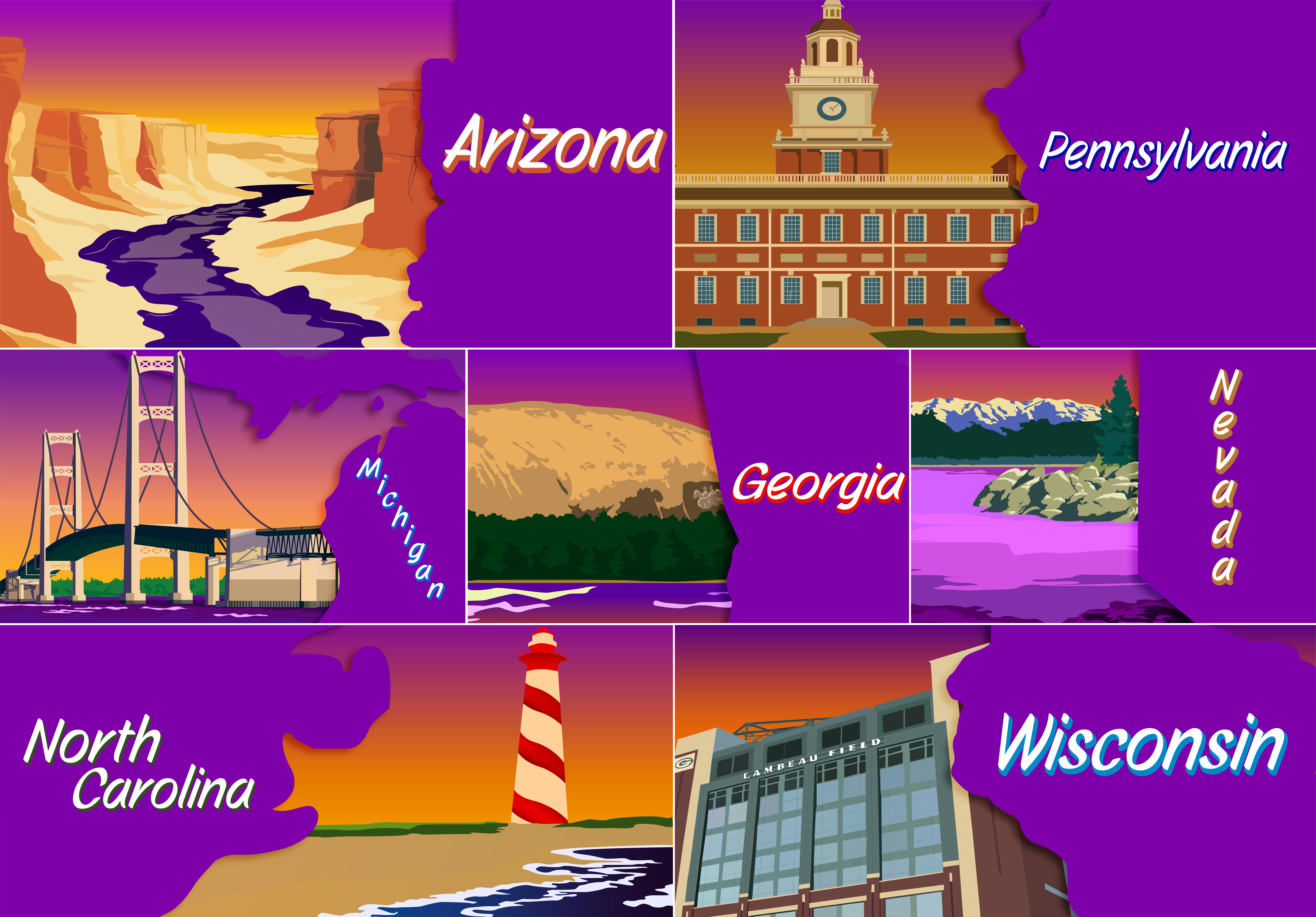
Leading up to a presidential election, there’s a lot of attention on swing states, from color-coded maps on TV to viral clips of candidates’ small-town visits. Also known as battleground, toss-up, and purple, these states — including places like Pennsylvania and Wisconsin — can decide the outcome of a United States presidential election.
In this article, we will look at what swing states are, explain why they are important during presidential elections, and give examples of current swing states.
What is a swing state?
According to the book, “Presidential Swing States: Why Only Ten Matter” researchers Stacey Hunter Hecht and David Schultz define a swing state as having three criteria:
- It “swings” between Republican and Democratic candidates in recent presidential elections.
- It has a close margin of victory (less than 5%) between the winner and second-place candidate.
- It is a “bellwether” in that its chosen candidate often goes on to win the national election.
The book also notes that, although the term “swing state” became more widely used in the 2000s, the phenomenon of certain states being competitive in elections has been around since the 1800s.
Meanwhile, the opposite of a swing state is called a safe state. This is a state that tends to favor one party, and candidates from that party can reasonably expect to win by a big margin. Examples of safe states include California, New York, Texas, and Wyoming.
These labels are not permanent, however. Political landscapes across the country have shifted throughout history. A state could be a battleground one decade and then lose that status the next, and vice versa, as pointed out by nonprofit USAFacts, which provides government data to voters. Florida and Virginia are examples of battleground states in the 1990s and 2000s that have been trending more safe in recent years.

How does a state become a swing state?
Two strong driving forces toward the creation of swing states are migration and economic changes. Both of these forces can shift political attitudes in a particular place, leading to support for new candidates and policies.
According to political scientist Ruy Texeira, one place where this is evident is the Mountain West, which used to be a Republican stronghold but has since become a more competitive battleground. In the book “America’s New Swing Region,” Texeira asserts that different processes occurring in states such as Arizona, Nevada, and New Mexico have “brought in millions of new residents from outside the region, raised educational levels, replaced older with younger generations, and powered the rise of dynamic metropolitan areas where the overwhelming majority of the Mountain West population now lives.”
Why do swing states matter so much in elections?
Elections are centered on swing states largely because of the U.S. Electoral College. Under this system, Americans vote for their president every four years by first having statewide elections, after which a predetermined number of electors (based on a state’s representation in Congress) cast ballots for each state’s chosen candidate in a winner-takes-all fashion. Exceptions are Maine and Nebraska, whose electoral votes are split by Congressional districts.
This creates a situation in which many states have predictable voting patterns election after election. States where the majority of voters lean Republican tend to give all their electoral votes to Republican candidates, and the same thing happens in Democratic-majority states.

Swing states, then, are seen as decisionmakers, leading them to receive outsized attention during elections.
Some legal scholars have criticized the existence of the Electoral College, which they believe gives voters from swing states more power than those from safe states. Lawrence Lessig, a Harvard Law School professor, is one such critic. Lessig said in an Oct. 26, 2020, Harvard Law Bulletin interview that “presidential campaigns only care about the swing states, and presidential policy bends to make the swing states happy, leaving the rest of the states behind.”
However, supporters of the Electoral College believe that the system works for a large and diverse country like the U.S. because it incentivizes presidential candidates to appeal to a broad range of voters rather than relying only on votes from the most populous states.
What are current and future swing states?
During the 2024 presidential election many political experts noted that the following were considered key swing states: Arizona, Georgia, Michigan, Nevada, North Carolina, Pennsylvania, and Wisconsin.
Given that this election centered on a potential second term for President Donald Trump, these swing states garnered plenty of attention from both Republican and Democratic campaigns. The fierce competition even caused them to become targets for widespread election subversion, as previously reported on by WeVote.
All seven swing states in 2024 cast their electoral votes for Trump, according to certified election results.
Nonetheless, experts are already making predictions about potential battlegrounds for the 2028 presidential election and beyond. For example, The Brookings Institution predicts that, based on 2024 exit poll analyses, places like Kansas, New Jersey, and New Hampshire could become competitive in the future, while Georgia and North Carolina could maintain their swing-state status for years to come.
As the nation continues to change, election campaigns will continue to change alongside it, moving the political spotlight from one state to another. For the average voter, this phenomenon can help explain why some places are highly prioritized on campaign trails and others receive much less attention.


Leave a Reply