
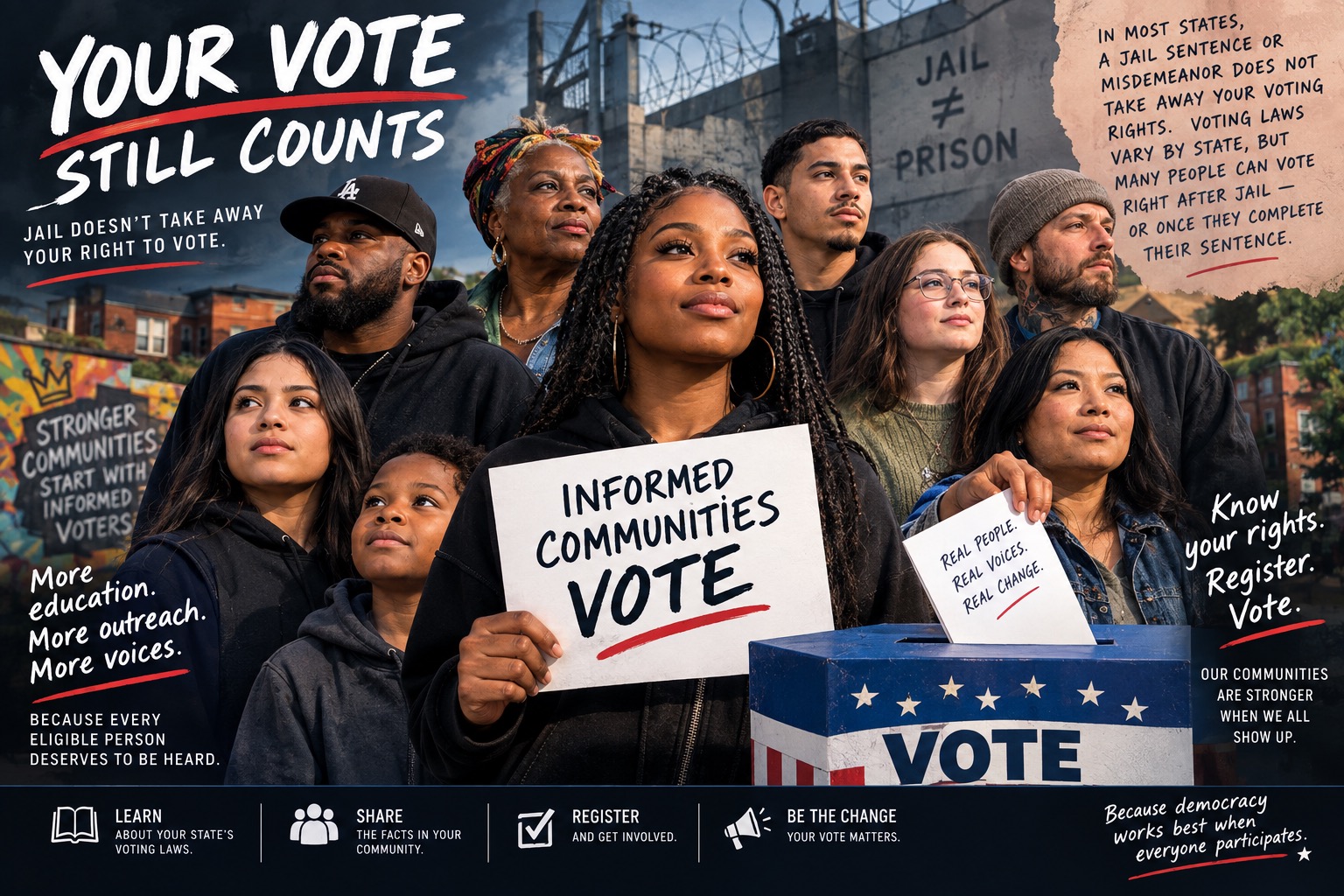
There’s a belief I’ve heard repeatedly in low income communities:
“If you’ve ever been to jail, you can’t vote.” That sounds like a fact. It isn’t necessarily.
Voting rights after a criminal conviction vary significantly from state to state. The U.S. Election Assistance Commission’s 2024 Election Administration and Voting Survey found that states have different rules concerning felony convictions, incarceration, probation, parole, and other circumstances.
And this is where it gets interesting.
California
California is a good example of why people shouldn’t automatically assume they have lost their voting rights. According to the California Secretary of State, a person with a felony conviction can generally register and vote while:
• awaiting trial
• serving a felony sentence in county jail
• on probation
• on parole
• on mandatory supervision
• on post-release community supervision
• on federal supervised release
The major restriction is for someone currently serving a state or federal prison sentence for a felony. Once that prison sentence is completed, the person’s right to vote is restored, although they need to register again.
New York
New York also demonstrates why the phrase “I have a felony, so I can’t vote” can be misleading. New York restores voting rights upon release from incarceration, even if the person is still on parole or post-release supervision. The person must re-register to vote. The New York Board of Elections specifically states that someone with a felony conviction who is not currently incarcerated may register and vote if they otherwise meet the qualifications.
Illinois
Illinois is another example.
A person with a criminal record can generally vote if they are not currently serving a sentence of confinement because of a conviction. Illinois allows people who have completed incarceration to vote even if they are on probation, parole, mandatory supervised release, or electronic monitoring.
Florida
Florida has different rules.
For many felony convictions, voting rights can be restored after all terms of the sentence have been completed, including incarceration, probation or parole, and court-ordered fines, fees, costs, and restitution. However, Florida treats felony murder and certain sexual offenses differently, and restoration for those offenses generally requires action by the State Clemency Board.
Texas
Texas also requires completion of the full sentence before a person with a final felony conviction can vote. That can include incarceration, parole, community supervision, and probation.
And then there are states with even different rules.
The National Conference of State Legislatures shows just how much these laws differ. For example, California, Illinois, New York, and several other states restore voting rights after incarceration, while other states can keep restrictions in place through probation or parole or require additional steps before voting rights are restored.
Virginia is another complicated example, and its law is changing. Virginia’s current constitution says a person convicted of a felony is not qualified to vote unless their civil rights have been restored. At the same time, Virginia enacted 2026 legislation addressing restoration of voting rights after incarceration, with provisions that have future effective dates and are tied to a proposed constitutional amendment.
That is exactly why people should check the law in the state where they are registered to vote rather than relying on something they heard years ago.
Because sometimes people aren’t choosing not to vote. They’ve been told they aren’t allowed to. A rumor repeated enough times can start sounding like law. So if you’ve been arrested, spent time in jail, or have a felony conviction in your past, please don’t automatically assume your vote has disappeared. Check the law, Check your state’s election office, and Check your voter registration status. And most importantly, Know your rights because although the rules aren’t the same everywhere, you actually might have more voting rights than you thought you did.
Start with these resources:
• California Secretary of State — Voting Rights for People With Prior Felony Convictions
• National Conference of State Legislatures — Felon Voting Rights by State
• U.S. Election Assistance Commission — 2024 Election Administration and Voting Survey
• New York State Board of Elections — Voting After Incarceration


Leave a Reply