
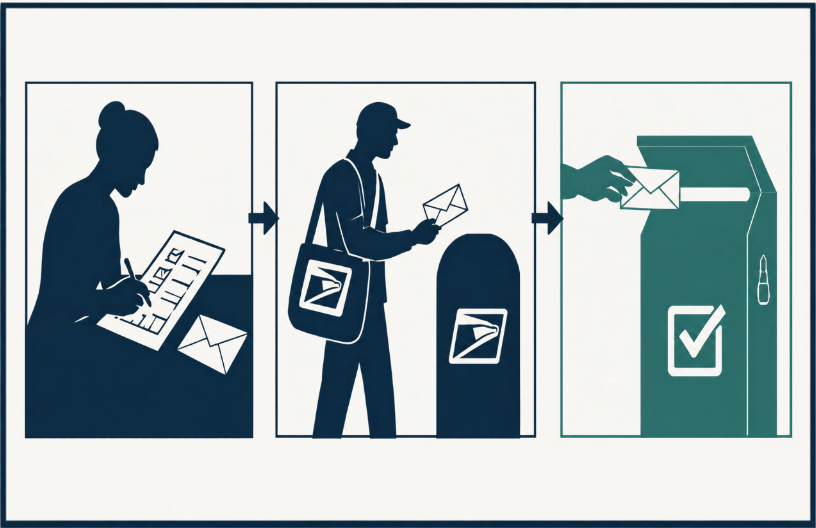
Despite the long tradition of absentee voting dating back to the American Civil War (Postal Museum, Smithsonian), American voters continue to ask critical questions about the mechanisms of safely receiving and returning their ballots. Whether via the United States Postal Service or by ballot drop boxes, absentee voting now accounts for nearly one-third of all votes cast, as reported by States United Democracy Center. Protocols are updated constantly through collaboration between election officials and the USPS in order to tightly secure mail-in ballots.
United States Postal Service
As of September 14, 2026, the Supreme Court struck down an Executive Order to add unprecedented restrictive conditions on the USPS distribution of ballots, as reported by the SCOTUS Blog. The lawsuit, brought by the League of Women Voters of Massecheusettes and represented by the American Civil Liberties Union, argued that the USPS and the Executive Branch may not interfere in state elections and the required modifications to the ballot would have constituted interference.
As a result of the discourse surrounding the SCOTUS case, trust in the USPS to properly manage mail-in ballots is dropping, according to National Public Radio.
However, according to a memo from the USPS to employees, all policies and procedures historically enacted to expedite ballot processing are in place. The USPS is fully prepared to act quickly and securely. Preoarations include prioritizing ballots, ensuring sorting equipment is operational for extended periods and that employees are prepared to work overtime as needed.
The official mail guide of the 2026-2027 election season sent from the USPS to election officials, mandates that all outbound election mail is sent first class. Not to be confused with “political mail” which is mail sent by candidates, “election mail” is mail sent to and from election officials.
The Intelligent Mail® barcode (IMb®) is a postal code tool applied to all mail and is used on individual voter’s ballots. In a home with multiple voters, IMb is specific to the voter, not the address. This code allows immediate tracking of the ballot as it passes through the system to and from the voter.
The USPS pressure-tests and updates the process of handling election mail. Along with the IMb, the trademarked logo usually appears (but is not strictly required) on all ballots. The logo helps postal workers more clearly and quickly sort mail:

We should not use commercial mail carriers like FedEx and UPS. Commercial carriers do not utilize the same tracking methods employed by USPS specifically for the purposes of ballot tracking. Reuters
Ballot Drop Box
An oft-cited concern regarding ballot boxes is their security. The ballot drop boxes are often under video surveillance, always locked, and managed by a strict chain of custody protocol. “Only election officials (often bipartisan teams) are authorized to collect ballots once they are placed in a drop box,” explains the Election Assistance Commission
In a guidance memorandum written for election officials by the Cybersecurity and Infrastructure Security Agency (CISA), ballot drop boxes may be the preferred method to return a ballot by some voters. Of particular value is the ability to drop off the ballot up to the last minute of election day. In some states, election mail may need to be postmarked or even received ahead of election day. You can visit the National Conference of Legislatures to find out what your state requires. In the case that you have exceeded that deadline, a ballot drop box is an important option.
Ballot drop boxes may be staffed or unstaffed, permanent or temporary, 24-hour day or business hours, well lit, and in some cases under video surveillance, per NCL.
Teams of local government employees who have taken sworn oaths to protect the integrity of the election perform the following duties: removing ballots and temporary drop boxes, locking permanent drop boxes on election night, conducting the chain of custody logs and transporting ballots to the elections office. Officials follow a strict protocol and log all procedures and movements as they transport returned ballots to the office of the county elections official. Upon receipt of the ballot delivery, the county elections official performs a set prescribed inspections of the ballot transfer container. California Code of Regulations, § 20137. Ballot Collection Procedures and Chain of Custody
Conclusion
Though the USPS takes painstaking steps to securely and efficiently transport ballots, some people feel that ballot drop boxes are more secure and more reliable. According to the Bipartisan Policy Center, this is specifically the preferred method when a voter’s main concern is getting the ballot to the election officials on time. However, in terms of security, both USPS and ballot drop boxes are tightly regulated and monitored.


Leave a Reply